What to Expect When You Contact Us?
-
USCIS Policy Manual, Chapter 2 – Definition of Child for Citizenship and Naturalization
-
USCIS Policy Manual, Chapter 3 – United States Citizens at Birth (INA 301 and 309)
-
USCIS Policy Manual, Chapter 4 – Automatic Acquisition of Citizenship after Birth (INA 320)
-
USCIS Policy Manual, Chapter 5 – Child Residing Outside of the United States (INA 322)
-
USCIS Policy Manual, Chapter 2 – Definition of Child for Citizenship and Naturalization
-
USCIS Policy Manual, Chapter 3 – United States Citizens at Birth (INA 301 and 309)
-
USCIS Policy Manual, Chapter 4 – Automatic Acquisition of Citizenship after Birth (INA 320)
-
USCIS Policy Manual, Chapter 5 – Child Residing Outside of the United States (INA 322)

Orpe Human Rights Advocates
Order for Restoring Peace on Earth (ORPE)
Restoring Human Dignity
Uniting Faith, Law, and Inclusive Action to Advance Rule of Law

Strengthening Defense Counsel Adversarial Litigation Skills
I. FOUNDATIONAL CONSTITUTIONAL DOCTRINES
(Normative Core of the Adversarial System)
These doctrines define the adversarial model as opposed to inquisitorial dominance
1. Equality of Arms Doctrine
-
Legal basis: ICCPR Art. 14; ECHR Art. 6; constitutional due process clauses
-
Core principle: Defense and prosecution must have procedural parity.
-
Operational effect: Access to evidence, witnesses, time, resources.
-
Rule-of-law impact: Neutralizes prosecutorial structural advantage.
4. Right to Counsel Doctrine
-
Effective assistance, not symbolic representation.
-
Includes competence, independence, preparation time.
2. Presumption of Innocence Doctrine
-
Burden rests exclusively on prosecution.
-
Defense has no obligation to prove innocence.
-
Operational tool: Motions for acquittal; directed verdict standards.
5. Public Trial & Transparency Doctrine
-
Ensures accountability of prosecutorial and judicial conduct.
3. Burden of Proof Beyond Reasonable Doubt
-
Prosecutor must prove every element.
-
Defense training emphasizes element-by-element dissection.
To establish the full doctrinal architecture associated with Orpe Human Rights Advocates programs advancing an adversarial judicial system through strengthening defense lawyers, we must anchor the framework in comparative criminal procedure theory, constitutional due process jurisprudence, and rule-of-law institutional design.
Below is a structured doctrinal matrix organized by Foundational Principles → Structural Doctrines → Litigation Doctrines → Ethical & Institutional Doctrines → System-Transformation Doctrines.
II. STRUCTURAL ADVERSARIAL DOCTRINES
(Institutional Architecture Shift from Inquisitorial Practices)
6. Party Presentation Principle
-
Parties control evidence presentation.
-
Judges are neutral arbiters, not investigators.
7. Judicial Impartiality Doctrine
-
Separation between adjudicator and investigative authority.
-
Recusal and bias standards.
8. Prosecutorial Disclosure Obligation Doctrine
-
Full disclosure of exculpatory evidence.
-
Defense capacity-building focuses on enforcing disclosure.
9. Illegally Obtained Evidence Exclusion Doctrine
-
Suppression motions as adversarial enforcement tool.
10. Open-File Discovery Doctrine
-
Structural transparency to counter investigative secrecy.
IV. ETHICAL & PROFESSIONAL RESPONSIBILITY DOCTRINES
(Defense as Guardian of Constitutional Order)
17. Duty of Zealous Representation
-
Within bounds of law.
-
Protects accused against state overreach.
18. Independence of the Defense Bar Doctrine
-
Institutional autonomy from executive influence.
19. Confidentiality & Attorney–Client Privilege Doctrine
-
Encourages full disclosure from accused.
20. Conflict-of-Interest Doctrine
-
Ensures loyalty and fairness.
21. Good Faith Prosecutorial Accountability Doctrine
-
Defense empowered to challenge abuse of discretion.
III. CORE ADVERSARIAL LITIGATION DOCTRINES
(Skill-Based Litigation Competencies Strengthened by ORPE Programs)
11. Cross-Examination Doctrine
-
Primary truth-testing mechanism.
-
Techniques: impeachment, prior inconsistent statements, bias exposure.
12. Confrontation Doctrine
-
Accused has right to confront witnesses.
-
Limits reliance on written dossiers.
13. Objection & Evidentiary Gatekeeping Doctrine
-
Defense as procedural guardian.
-
Hearsay, character evidence, relevance, foundation objections.
14. Motion Practice Doctrine
-
Pre-trial motions to dismiss, suppress, exclude.
-
Forces prosecutorial compliance with constitutional standards.
15. Strategic Case Theory Doctrine
-
Narrative construction from defense perspective.
-
Counters prosecutorial framing.
16. Adversarial Fact Development Doctrine
-
Independent investigation by defense.
-
Witness preparation ethics.
V. SYSTEM-TRANSFORMATION DOCTRINES
(Dismantling Inquisitorial Behavioral Residues)
22. Oral Trial Supremacy Doctrine
-
Verdict based on oral evidence tested in court, not investigative dossier.
23. Adversarial Case Management Doctrine
-
Equal opportunity scheduling, preparation time.
24. Defense Resource Parity Doctrine
-
Access to experts, forensic testing, investigators.
25. Constitutional Supremacy Doctrine
-
Courts must invalidate practices inconsistent with due process.
26. Structural Fairness Doctrine
-
Fairness measured institutionally, not only case-by-case.
27. Remedy and Sanction Doctrine
-
Dismissal, exclusion, mistrial as enforcement tools.
28. Anti-Coercion Doctrine
-
Protection against forced confessions and custodial abuse.
29. Appellate Review Doctrine
-
Defense ensures error correction and precedent development.
30. Rule-of-Law Internalization Doctrine
-
Behavioral shift from authority-based adjudication to rights-based adjudication.

PROGRAMMATIC APPLICATION FOR ORPE
A Defense-Litigation Strengthening Program built around these doctrines would include:
-
Cross-examination laboratories
-
Suppression motion drafting workshops
-
Prosecutorial misconduct litigation simulations
-
Judicial bias challenge training
-
Strategic case-theory development clinics
-
Constitutional objection mastery modules
-
Monitoring & evaluation of courtroom behavioral shifts
SYSTEMIC OBJECTIVE
The overarching objective of these doctrines within ORPE’s programmatic framework:
To structurally rebalance judicial power by equipping defense lawyers with doctrinal tools that enforce prosecutorial constitutional compliance, institutionalize equality of arms, and transition the justice system from file-driven inquisitorial culture to rights-centered adversarial adjudication.
PRACTICAL ADVERSARIAL LITIGATION TRAINING CURRICULUM
Below is a structured, competency-based practical training curriculum designed to advance adversarial judicial practice by strengthening courtroom performance of defense lawyers, prosecutors, and judges.
The curriculum emphasizes applied litigation techniques, structured feedback, doctrinal alignment with due process principles, and institutional behavioral reform.
Target Group: Defense Counsel, Prosecutors, Trial Judges
Duration: 5–7 Intensive Days (Modular Format)
Methodology: Simulation-Based | Skills Lab | Bench Feedback | Peer Review | Video Analysis
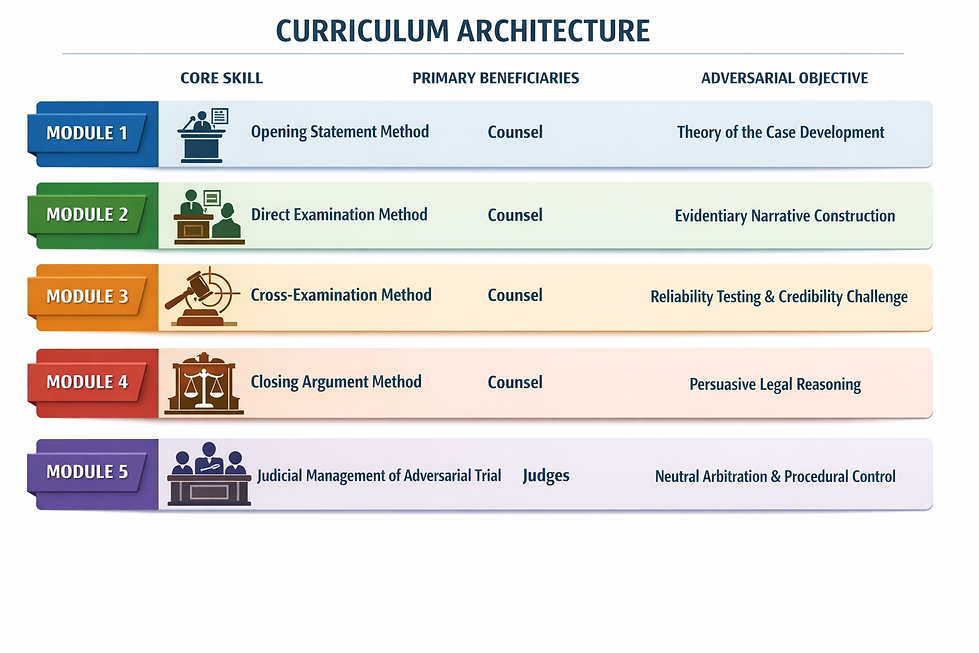
MODULE 1: OPENING STATEMENT METHOD
1. Learning Objectives
Participants will:
-
Develop a coherent theory of the case
-
Present a fact-based roadmap (not argument)
-
Frame legal elements through factual storytelling
-
Avoid improper advocacy during opening
2. Core Techniques
A. Structure Formula (IRR Model)
-
Introduction (Theme)
-
Rule (Elements of offense/defense)
-
Roadmap (What evidence will show)
B. Key Principles
-
No argument
-
No personal opinion
-
Use simple language
-
Establish credibility immediately
3. Practical Exercise
Scenario 1: Armed Robbery Case
Facts Summary:
Defendant accused of robbing a shop at night. Prosecution relies on eyewitness and CCTV. Defense claims mistaken identity.
Exercise A: Prosecutor Opening (10 minutes)
Focus:
-
Establish timeline
-
Identify elements of robbery
-
Preview eyewitness testimony
Exercise B: Defense Opening (10 minutes)
Focus:
-
Frame identification weaknesses
-
Introduce doubt without arguing
-
Set up cross-examination strategy


MODULE 2: OPENING STATEMENT METHOD
1. Learning Objectives
Participants will:
-
Use non-leading questions
-
Build chronological narrative
-
Introduce exhibits properly
-
Avoid witness coaching
2. Direct Examination Formula
Funnel Method
-
Open-ended background
-
Narrow into incident
-
Highlight key evidence
-
Conclude with impact
3. Practical Exercise
Funnel Method
-
Open-ended background
-
Narrow into incident
-
Highlight key evidence
-
Conclude with impact
3. Practical Exercise
Scenario 2: Domestic Assault Case
Witness: Alleged victim
Evidence: Medical report, text messages
Prosecutor Exercise:
Conduct full 20-minute direct examination.
Required Elements:
-
Establish identity
-
Lay foundation for medical report
-
Introduce text messages
-
Show emotional impact without theatrics
Defense Exercise:
Direct examination of defense alibi witness.
Focus:
-
Establish timeline
-
Neutral tone
-
Avoid over-preparation signals
Judges' Role:
-
Rule on objections
-
Monitor leading questions
-
Provide structured feedback
Competency Checklist
Skill
Question form
Evidence foundation
Logical sequencing
Witness control
Measured by
% of open-ended
Proper exhibit introduction
Chronological clarity
No narrative chaos
MODULE 3: OPENING STATEMENT METHOD
1. Learning Objectives
Participants will:
-
Use leading questions effectively
-
Control witness
-
Extract admissions
-
Avoid open-ended questions
-
Know when to stop
2. Cross-Examination Principles
The Three Golden Rules:
-
Ask only leading questions
-
One fact per question
-
Never ask what you don’t know
3. Tactical Models
A. Impeachment Model
-
Prior inconsistent statement
-
Bias
-
Perception limitations
B. Credibility Diminution Model
-
Lighting conditions
-
Distance
-
Time lapse
4. Practical Exercise
Scenario 3: Eyewitness Identification
Facts:
-
Crime occurred at night
-
Witness 20 meters away
-
Lighting poor
-
6 months delay before ID
Defense Cross Exercise:
Objective:
-
Establish environmental limitations
-
Extract admission of uncertainty
-
Undermine reliability
Prosecutor Cross Exercise:
Witness: Defense alibi witness
Objective:
-
Establish bias
-
Expose timeline inconsistencies
Judges:
-
Enforce objections
-
Prevent harassment
-
Maintain neutrality
Performance Indicators
Metric
Control
Precision
Strategy
Damage assessment
Evaluation
Witness confined to yes/no
No compound questions
Clear objective per line
Did cross advance theory?
MODULE 4: CLOSING ARGUMENT METHOD
1. Learning Objectives
1. Learning Objectives
Participants will:
-
Argue evidence (not speculate)
-
Apply law to facts
-
Address weaknesses directly
-
Use structured persuasion
2. Closing Formula
CREL Structure
-
Claim
-
Rule
-
Evidence
-
Link
3. Practical Exercise
Scenario 4: Full Trial Simulation (Robbery Case)
Each team:
-
15-minute closing
-
5-minute rebuttal
Prosecutor Focus:
-
Tie testimony to statutory elements
-
Reinforce credibility of witnesses
-
Neutralize defense doubt
Defense Focus:
-
Emphasize burden of proof
-
Highlight inconsistencies
-
Argue reasonable doubt
Judges’ Deliberation:
-
Deliver short reasoned ruling
-
Identify strongest advocacy moments
-
Note improper arguments
Evaluation Criteria
Skill
Logical flow
Legal accuracy
Emotional discipline
Responsiveness
Measured by
Structured reasoning
Correct statement of burden
No inflammatory rhetoric
Addressed opponent’s theory
MODULE 5: JUDICIAL MANAGEMENT OF ADVERSARIAL TRIAL
Learning Objectives
Judges will:
-
Maintain neutrality
-
Control improper questioning
-
Rule efficiently on objections
-
Write concise reasoned decisions
Judicial Simulation Exercise
Scenario:
Defense objects during cross-examination for:
-
Harassment
-
Leading on direct
-
Hearsay
Judges must:
-
Rule immediately
-
Provide short explanation
-
Maintain courtroom authority without advocacy
INTEGRATED MOCK TRIAL (Capstone)
Day 6–7: Full adversarial simulation
Components:
-
Opening
-
Direct
-
Cross
-
Objections
-
Closing
-
Judgment
Video recorded → Feedback session → Performance scoring.
Assessment Framework
1. Individual Skills Rubric (Score 1–5)
-
Theory coherence
-
Question control
-
Evidence handling
-
Objection response
-
Persuasive reasoning
2. Institutional Outcome Indicators
-
Reduced judicial intervention in questioning
-
Increased objection literacy
-
Clear separation of roles
-
Reduced inquisitorial behavior
Pedagogical Methods
-
Micro-skills drills
-
Rotating role-play
-
Objection flash drills
-
Peer scoring sheets
-
Structured bench commentary
Expected Outcomes
Participants will demonstrate:
-
Structured opening without argument.
-
Chronological and evidentiary discipline in direct.
-
Controlled, strategic cross-examination.
-
Legally reasoned, evidence-based closing.
-
Judicial neutrality and procedural authority.