What to Expect When You Contact Us?
-
USCIS Policy Manual, Chapter 2 – Definition of Child for Citizenship and Naturalization
-
USCIS Policy Manual, Chapter 3 – United States Citizens at Birth (INA 301 and 309)
-
USCIS Policy Manual, Chapter 4 – Automatic Acquisition of Citizenship after Birth (INA 320)
-
USCIS Policy Manual, Chapter 5 – Child Residing Outside of the United States (INA 322)
-
USCIS Policy Manual, Chapter 2 – Definition of Child for Citizenship and Naturalization
-
USCIS Policy Manual, Chapter 3 – United States Citizens at Birth (INA 301 and 309)
-
USCIS Policy Manual, Chapter 4 – Automatic Acquisition of Citizenship after Birth (INA 320)
-
USCIS Policy Manual, Chapter 5 – Child Residing Outside of the United States (INA 322)

Orpe Human Rights Advocates
Order for Restoring Peace on Earth (ORPE)
Restoring Human Dignity
Uniting Faith, Law, and Inclusive Action to Advance Rule of Law

Mobilizing the Church for Doctrine-Based Human Rights and Legislative Advocacy
Executive Summary
Across many contexts, communities, especially the poor, detained, marginalized, and excluded, experience persistent violations of human dignity, injustice, and weak accountability. While international and domestic human rights frameworks exist, implementation gaps remain, often compounded by moral silence or institutional disengagement.
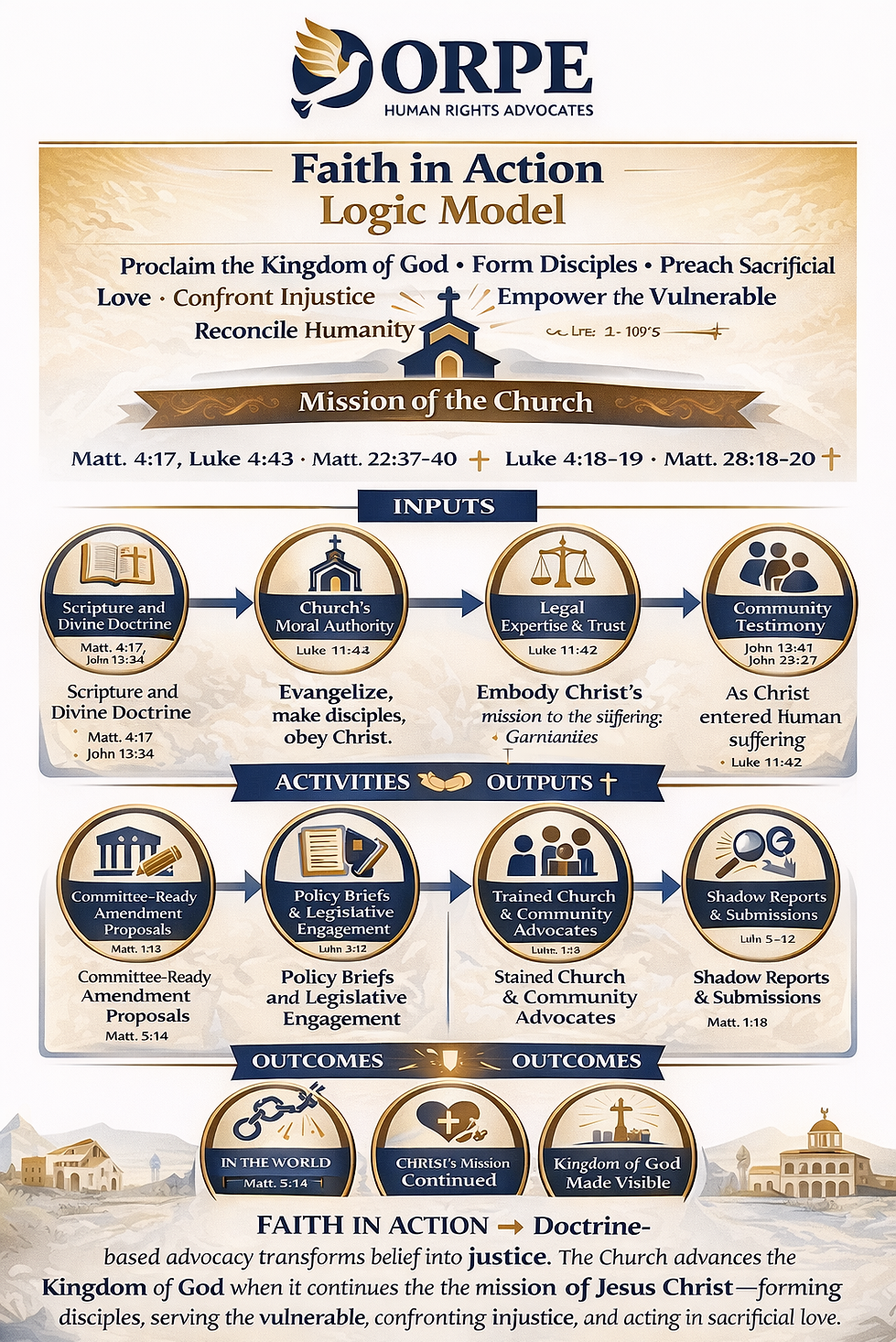
This project mobilizes the Church to reclaim its original mission as mandated by Jesus Christ to proclaim the Kingdom of God through liberation, justice, love, and truth and to translate that mission into effective, non-partisan legislative and policy advocacy grounded in Divine Law and aligned with international human rights standards.
By strengthening church capacity for doctrine-based advocacy, producing committee-ready policy tools, and engaging national and international accountability mechanisms, the project aims to protect human dignity, reform unjust laws, empower vulnerable communities, and restore the Church’s credible public witness.
Manifesting the Kingdon of Heaven on Health

Theory of Change
The Problem
-
Persistent violations of:
-
Human dignity
-
Liberty and due process
-
Equality and non-discrimination
-
-
Weak accountability for abuses of power
-
Limited civic and moral pressure for reform
-
Churches often confined to charity or silence, rather than justice-oriented action
Root Causes
-
Disconnect between moral authority and policy action
-
Limited church capacity in legal, legislative, and human rights advocacy
-
Absence of doctrine-based, committee-ready policy tools
-
Weak engagement with accountability mechanisms (courts, legislatures, treaty bodies)
-
Fragmentation between faith teaching and human rights practice.
The Gaps
-
Legal frameworks exist, but moral authority is underutilized
-
Civil society advocacy often lacks deep community trust
-
Churches possess legitimacy and reach, yet lack:
-
Policy literacy
-
Advocacy tools
-
Structured engagement pathways
-
Core Assumptions
If the Church reclaims its Christ-mandated mission to proclaim the Kingdom of God through justice, liberation, love, and truth, and translates that mission into competent, non-partisan, doctrine-based legislative and policy advocacy, then unjust laws can be reformed, accountability strengthened, and human dignity meaningfully protected.
Doctrinal Imperative
Jesus Christ explicitly commissions His Church to:
-
Proclaim liberation (Luke 4:18–19)
-
Defend the vulnerable (Matthew 25)
-
Speak truth to power (Prophetic witness)
-
Serve rather than dominate (Mark 10:45)
Failure to act is both a moral failure and a justice failure.
Change Pathways
IF
-
Church leaders are equipped with doctrinal, legal, and advocacy capacity, and
-
Faith-based actors produce credible, committee-ready policy and legislative tools, and
-
Churches engage national and international accountability mechanisms in alignment with human rights standards,
THEN
-
The Church becomes an effective, principled advocate for justice,
-
Legislators and institutions receive morally grounded, legally sound reform proposals, and
-
Vulnerable communities gain protection, voice, and access to remedies,
RESULTING IN
-
Reformed unjust laws and policies
-
Improved accountability and rule of law
-
Restored credibility of the Church’s public witness
-
Sustained protection of human dignity.
Program Goal and Objectives
Overall Goal
To advance human dignity and justice by empowering churches to engage in doctrine-based, faith-consistent human rights and legislative advocacy.
Specific Objectives:
-
Strengthen Church Advocacy Capacity
-
Equip church leaders with doctrinal, legal, and policy advocacy skills.
-
Influence Just Laws and Policies
-
Produce and submit doctrine-based, committee-ready legislative briefs.
-
Amplify the Voices of the Vulnerable
-
Center lived experiences in policy reform efforts.
-
Engage Accountability Mechanisms
-
Support church participation in UN, EU, and AU human rights processes.
-
Restore the Church’s Prophetic Public Witness
-
Align faith, action, and justice in visible and credible ways.
Influencing Change in Policy Mechanism

Recognizing Dignity as the Foundation of Peace

Advocacy Practice and Policy Model
